English is recognised as a means of communicating through the elements of Speaking and Listening, Reading and Writing.
Our Vision Statement
At St Mary’s we provide evidence-based, literacy instruction for all learners. We promote an environment where building pedagogical knowledge is paramount; empowering teachers to deliver high-quality instruction that meets the learning needs of all students. In collaboration with all stakeholders we assess, analyse and respond to data to monitor student growth and ensure responsive teaching. We aim to empower all learners to strengthen their skills in Oral Language, Reading and Writing; giving them the essential tools to actively engage in their world.
How Learners Learn: Our overarching principles of instruction in Literacy
Cognitive science research offers important information on how learning happens with practical implications for teaching. We align these beliefs in our approach to teaching Literacy.
These include:
- Explicit teaching is required to learn biologically secondary knowledge (Reading and Writing)
- Learning is a change in long-term memory
- Memory is prone to forgetting; review can strengthen previous learning and lead to fluent recall
- Students process limited amounts of new information
- Students develop and demonstrate mastery
- Students are actively engaged when learning
Teaching Literacy at St Mary’s
Oral Language
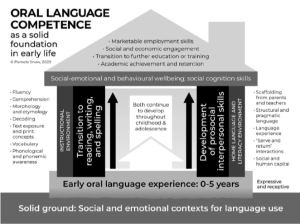
A large body of research indicates that oral language is critically important to achievements in reading and writing and has a direct impact on social emotional wellbeing. We need to support children with skills that are biologically natural, such as speaking, to what is not, such as reading and writing.
Relevant Readings:
ICPALER – Oral Language Introduction
SOLAR: The Science of Language and Reading
Implications for Instruction in Oral Language at St Mary’s:
- Frequent opportunities for students to develop their skills in speaking and listening through:
- Encouraging speaking in whole sentences.
- Development of social and emotional contexts for language use including functional language and conversational skills
- Regular whole class and small group discussion
- Opportunities to share and engage with peers
- Think/Pair/Share
Story Grammar Macrostructure:
- Categories needed to retell and create a complete story
- Explicit vocabulary instruction
- Oral retell of shared texts
Language Microstructure:
- Developing the finer units of language that develop mastery
- Grammar
- Tense
- Use of conjunctions
- Sentence development
Reading:
The ability to read proficiently is fundamental to a student’s success at school and in later life. The science of reading provides the strongest evidence about how young children learn to read. Understanding the cognitive science behind how students learn to read and the research on effective instruction has underpinned our approach to teaching reading.
The research that underpins our instructional approaches in Reading are:
- The Simple View of Reading – Gough and Tumner (1986)
- The Big 6 or 5 Pillars of Reading
- Simple View of Reading Quadrants – Rose 2006
- Scarborough’s Reading Rope – Scarborough 2001
The simple view of reading Importantly, the Simple View of Reading states that reading comprehension is a product of word identification ability and language comprehension. If either of these two factors is absent, the student will not demonstrate reading comprehension.
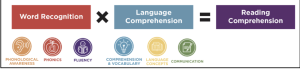
Our high-quality, evidence based Literacy Program comprises the following core areas:
- Phonemic awareness: the ability to identify and manipulate the individual speech sounds in words called phonemes.
- Phonics: knowledge of the relationships between letters and sounds, and the ability to use letter-sound relationships to decode words.
- Fluency: the ability to read accurately, quickly, and expressively. Fluent readers can focus on reading for meaning.
- Vocabulary: knowledge of the meaning of words in isolation and in context.
- Comprehension: the ability to extract and construct meaning from written text.
Implications for Instruction in Reading at St Mary’s:
Phonemic Awareness:
- Formative Assessment at the beginning, middle and end of year is conducted in phonemic awareness in Prep and Year 1 to monitor progress over time.
- Phonemic Awareness is explicitly taught for 10 minute sessions daily in Prep and Year 1 with the use of the Heggerty Program.
- Intervention is provided for those students who require additional supports
Phonics:
- Implementation of a Scope and Sequence from Prep to Year 2 to ensure the systematic teaching of phonics.
- Morphology is explicitly taught as an extension of this in Years 3-6
- Correlations between decoding (reading) and encoding (spelling) are explicitly taught
- Consistent, daily retrieval is implemented after explicit instruction of sounds
- Spaced retrieval is implemented to ensure students are able to decode and encode explicitly taught phonemes and graphemes over time to ensure long term memory retention
Fluency:
- Focus on increasing word-level reading competency in order to improve reading fluency
- Repeated exposure to texts to enhance fluency
- Fluency sessions are incorporated at least three times per week for a minimum of ten minutes from Prep to Year Six
- Paired Fluency routines are established in each classroom for students to review and provide feedback consistently.
- Fluency is assessed regularly throughout the year to monitor progress
Vocabulary:
- High-level vocabulary (encouraging mature use of language) is explicitly taught weekly in all classrooms from Prep to Year Six
- Multiple exposures to vocabulary words are incorporated in lessons that explicitly teach:
- Word definitions
- Word associations (Synonyms and Antonyms)
- Visual representations of the word
- Sound chunks within the word
- Examples and non examples of words
- Words in context: Sentence development incorporating new vocabulary.
- Consistent daily retrieval is implemented after explicit instruction.
- Spaced retrieval is implemented to ensure students are able to understand and apply words in context over time to ensure long term memory retention
Comprehension:
- Comprehension is developed orally through oral retells
- Knowledge-rich curriculum is incorporated to allow students to build context and apply background or general knowledge to new learning
- Developing the skill of generating questions and thinking about and beyond the text in order to build deeper understandings
- Formative and summative assessments are incorporated into our Assessment Schedule to monitor student growth.
Writing:
Reading and Writing are foundational to all other learning areas. Implementing evidence-based instructional practices enhances students’ writing skills and confidence while fostering a deeper understanding, enjoyment of, and appreciation for the writing process.
At St Mary’s our writing instruction is aligned to principles from The Writing Revolution and endeavours to provide a Knowledge Rich Curriculum where connections between Reading and Writing are made explicitly.
The principles that underpin our current approach to Writing are:
- the explicit teaching of writing skills, through children’s own writing practice
- the centrality of the sentence, as the basic building block of all good writing
- the progression from simple to more complex strategies (sentences, to paragraphs, to creating text)
- the content (knowledge) about which students write drives the rigour
The purpose of teaching in this way is to ensure that all students become proficient writers, not just those who enjoy writing already. This approach also allows stronger writers to more explicitly manipulate their language choices and understand the why and how of good writing and grammar.
Implications for Instruction in Writing at St Mary’s:
Writing is one of the most cognitively complex skills for our brains to master. It requires many working parts to become proficient writers and this needs extensive and explicit instruction. Ultimately, we know that writing does not sit simply within the ‘writing session; and is a skill transferable in all learning areas. We also know that writing is an expression of our thinking and we must nurture this wonderfully complex learning in a way that empowers students to explore their thinking and express themselves through the writing process.
At St Mary’s we endeavour to explicitly develop the following skills in order to build proficiency in writing.
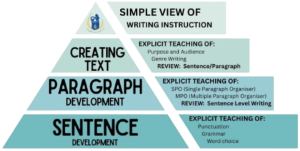
- Spelling: Spelling is one of the fundamental mechanics of writing and is linked closely with decoding and our ability to hear sounds in words. In order to be successful spellers we must make connections between phonemes (the sounds we hear) and graphemes (the corresponding letters that represent these sounds) to spell. At St Mary’s we endeavour to teach these skills simultaneously.
- Sentence Development: Sentences are the building blocks of all writing. If students are unable to grasp the concept of sentence formation, they will never be able to successfully create text. We follow the basic sequence of sentence development from The Writing Revolution (Hochman & Wexler) to drive our explicit teaching of sentence structure.
- Punctuation: Punctuation is taught in context with sentence development. It not only allows us to convey and read with expression but also to assist in teaching sentence types. Another mechanic of writing, punctuation cannot be taught in isolation and is an important tool for students to use when creating expression as writers.
- Grammar: In conjunction with sentence development, grammar and punctuation is a way to allow students to become more proficient and sophisticated writers. Grammar and syntactic structure is taught explicitly in conjunction with sentence development to enhance writing proficiency. At ST Mary’s we believe if grammar is taught in isolation it will not transfer skills or improve general writing practices.
- Vocabulary/Word Choice: Understanding and making informed and sophisticated word choices is explored through reading and writing. We make clear and explicit connections to improve comprehension and written work (sentence level and planning and creating text). At St Mary’s we want to see transference of skills and that is observed most effectively when students are able to use academic and sophisticated vocabulary in both their oral language and writing.
- Creating Text: Creating text incorporates all explicitly taught writing skills in order to achieve proficiency and writing mastery. When students are able to manipulate and play with languages and use them for particular purposes, we see cohesion and fluency in whole text development.
We explore:
- Paragraph level writing
- Scaffolded planning (The Writing Revolution)
- Single Paragraph Organisers
- Multiple Paragraph Organisers
- Note taking
- Recording sentences with the conscious use of punctuation, grammar and word choice.
- Editing and revising to make improvements and refine